

Every year, accounting firms handle thousands of documents containing some of the most sensitive financial data imaginable: tax returns, payroll records, audit reports, and personal identification information. And every year, firms that fail to protect that data face regulatory penalties, damaged client relationships, and reputational harm that can take years to recover from.
The difference between firms that thrive and those that struggle often comes down to one critical operational decision: how they approach secure file sharing.
This is not just a technology question. It is a question of professional responsibility, client trust, and regulatory compliance. Whether you are working with individual tax clients or managing financial records for large corporate accounts, the way you send, receive, and store documents signals to your clients exactly how seriously you take their security.
In this post, we break down the seven key practices that separate compliant, client-ready accounting firms from vulnerable ones. If you are ready to evaluate where your firm stands and make smarter decisions about how you handle sensitive documents, you are in the right place.
The Real Problem Is Habits, Not Technology
Most accounting firms already own tools capable of secure file transfer. The problem is that those tools rarely get used consistently, because the familiar path feels faster than the secure one. When a client needs to send a bank statement urgently, they text it. When a staff member needs to forward a payroll file internally, they email it. The technology exists; the habit overrides it. According to the Verizon 2025 Data Breach Investigations Report, 74% of all breaches include a human element, a figure that underscores how thoroughly behaviour, not infrastructure, drives exposure.
The client side of this problem is particularly persistent. Clients email tax file numbers, drop identity documents into shared consumer folders, and send bank statements via SMS without any understanding of who can access that data downstream. This is not carelessness; it is the predictable result of never being offered a better alternative that feels equally simple. If the secure channel requires a new login, a file size limit, or an unfamiliar interface, most clients will quietly revert to email within a week.
Internally, the pattern compounds the risk further. Files downloaded to local drives get renamed inconsistently, forwarded to colleagues, and saved in multiple locations simultaneously. The result is a collection of uncontrolled copies with no clear audit trail and no reliable record of who accessed what or when. This matters beyond compliance: when a client disputes whether a document was received, an audit trail is the only objective record available.
The habits problem is self-reinforcing by nature. The longer a firm tolerates informal document handling, the harder it becomes to introduce a different standard, particularly with long-standing clients who have been emailing sensitive files for years. Framing secure file sharing as a technology upgrade misses this dynamic entirely. As research on spear phishing and human behaviour consistently shows, the real intervention is making the secure path the default path, so that staff and clients both reach for it first, not as a conscious policy decision, but simply because it is the easiest option available.
1. The Threat Landscape Facing Accounting Firms in 2026
Understanding the threat environment is not optional for accounting firms in 2026. It is the foundation on which every secure workflow decision must be built. The risks have compounded significantly, and the consequences of underestimating them are now measured in regulatory penalties, destroyed client relationships, and in some cases, permanent firm closure.
Phishing Has Entered a New Era
Phishing remains the dominant attack vector targeting accounting practices, and it is materially more dangerous today than it was two years ago. Attackers now deploy AI-generated emails and spoofed cloud-sharing links that are virtually indistinguishable from legitimate platforms, replicating the visual design, sender formatting, and user experience of services accountants use every day. The FBI's 2024 Internet Crime Report recorded $16.6 billion in U.S. cybercrime losses, a 33% increase from 2023, with phishing campaigns specifically timed to IRS deadlines among the primary vectors targeting CPA workflows. According to cybersecurity threats every CPA firm should prepare for in 2026, no firm is immune regardless of size or client base.
Insider Threats Are Structural, Not Malicious
The insider threat problem facing accounting firms is largely a structural failure rather than a deliberate one. Shared passwords, personal devices used for work, no formal off-boarding processes for departing staff, and informal habits around document handling collectively create access control gaps that persist invisibly until something goes wrong. Verizon's 2025 Data Breach Investigations Report found that third-party involvement in breaches doubled to 30% year-over-year, compounding the internal control weaknesses that smaller firms rarely have the resources to fully address.
Seasonal Spikes and the Small Firm Targeting Problem
Tax season creates a predictable and exploitable vulnerability window. Compressed deadlines produce rushed workflows, and rushed workflows produce misdirected emails, accidental attachments, and skipped verification steps. Attackers know this calendar well and time campaigns accordingly. Compounding the seasonal risk, small and mid-tier firms are now disproportionately targeted because they hold high-value financial documents, including tax returns, payroll files, and entity financials, while lacking the enterprise-grade security infrastructure of larger institutions. Research into insider threat statistics confirms that smaller organizations consistently face higher per-incident impact when controls are informal.
The Cost Equation Does Not Favor Small Firms
The financial sector benchmark for combined direct and indirect breach losses sits above USD $6 million. For a small accounting firm, even a fraction of that figure triggers regulatory investigations under frameworks such as the FTC Safeguards Rule, erodes client trust that took years to build, and can permanently damage the firm's reputation with no equivalent financial buffer to absorb the fallout. The asymmetry is stark: attackers have little to lose and much to gain, while small firms have everything to lose and limited infrastructure to defend themselves.
2. Why Email and Shared Drives Are Structurally Insecure
Email was not designed to carry sensitive financial documents, and the structural evidence of this is visible at every point in its architecture. When an attachment leaves a sender's inbox, it does not travel as a single controlled object. It is copied simultaneously to the sender's sent folder, the outgoing mail server, any device that has ever synced that account, the recipient's mail server, and the recipient's inbox. Each of those locations represents an independent exposure point. TLS encryption, which many firms rely on for reassurance, only protects messages in transit. It does nothing to protect stored attachments, messages at rest, or forwarded copies once delivery is complete. The assumption that email is "encrypted" is one of the most persistently dangerous misconceptions in professional services.
Shared drives introduce a distinct but equally serious problem. Access permissions in consumer-grade platforms are typically configured once, during initial setup or onboarding, and rarely revisited thereafter. Former employees, former clients, and contractors who left months ago may retain full access to sensitive folders with no automatic expiration or review trigger. In the financial services sector, an average of 449,855 sensitive files are exposed per organization, with 36,004 of those accessible to every employee. There is typically no granular audit log recording who downloaded which file, when, or to which device.
Both methods produce uncontrolled document copies at scale. Once a tax return is emailed, the sending firm has no mechanism to recall it, prevent forwarding, or confirm deletion after review. That document may exist across dozens of personal and professional inboxes, synced mobile devices, and local hard drives, with no visibility into how many copies exist or where they are stored. Approximately 30% of files are shared with personal accounts, bypassing any corporate oversight entirely.
Version management compounds every one of these risks. Multi-round email review of financial reports or draft filings generates multiple concurrent versions with no reliable mechanism to identify the current one. In a regulated context, version confusion is not an administrative inconvenience. It is a direct source of compliance and liability exposure.
These are not edge-case failure modes triggered by unusual circumstances. They are the predictable, structural outputs of tools that were built for general communication and retrofitted into workflows they were never designed to support. According to current data breach statistics and trends, human error and improper access controls consistently rank among the leading causes of data exposure, precisely because informal tools produce informal behaviors at scale. Accounting firms that continue to rely on email and shared drives for document exchange are not managing risk; they are systematically generating it.
 AI generated
3. Document Collection and Document Delivery Are Two Different Workflows
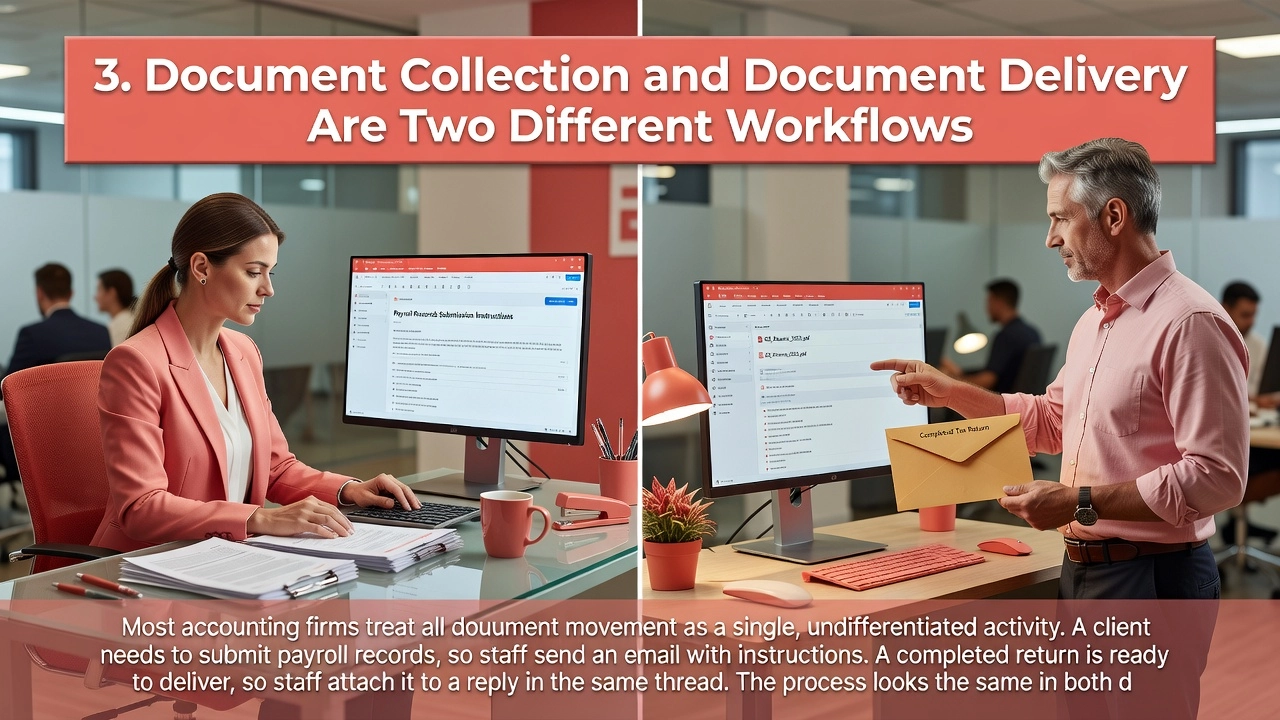
Most accounting firms treat all document movement as a single, undifferentiated activity. A client needs to submit payroll records, so staff send an email with instructions. A completed return is ready to deliver, so staff attach it to a reply in the same thread. The process looks the same in both directions, which is precisely the problem. This conflation produces inconsistent submissions, scattered file formats, no clear record of what has been received, and no reliable confirmation that final deliverables actually reached the client.
Collection Is an Intake Process
Document collection is a structured intake workflow. Gathering tax documents, bank statements, payroll records, and identity verification from clients requires itemized checklists, communicated deadlines, and real-time visibility into what has been submitted versus what remains outstanding. Without that structure, clients upload files to the wrong location, submit incomplete sets without realizing it, and staff spend meaningful time chasing follow-ups that a well-designed intake process would have prevented entirely.
The tracking function is not a convenience feature; it is operationally essential. During peak periods like tax season, a firm managing dozens of active clients simultaneously cannot rely on memory or inbox searches to know which clients have submitted complete documentation. The intake process needs its own logic, its own sequencing, and its own status visibility.
Delivery Requires a Different Set of Controls
Document delivery operates on a fundamentally different set of requirements. Sending a completed return, engagement letter, or signed agreement back to a client requires controlled access so only the intended recipient retrieves the file, confirmation of receipt so the firm has a verifiable record, and version control so the client cannot accidentally access a superseded draft. These controls have nothing to do with structured intake; they exist to protect the firm's record of what was delivered, when, and to whom.
When firms apply the same process to both directions, those controls collapse. Files get forwarded without access restrictions, receipt goes unconfirmed, and year-end records are incomplete.
The Operational Case for Separation
Firms that treat collection and delivery as distinct workflows consistently see shorter document turnaround times, fewer follow-up requests, and cleaner records at year end. That improvement is not incidental. It is the direct result of matching the process to the actual shape of the work. Secure file sharing for accountants functions most effectively when the direction of document flow determines the controls applied to it, rather than applying one generic approach to every exchange regardless of its purpose.
4. Access Control and Version Management Are Operational Necessities
Access control is not something accounting firms can afford to treat as an IT department concern. Every firm already makes access control decisions daily, whether deliberately or by default. When no one has configured permissions intentionally, access defaults to whatever the platform allows out of the box, and most general-purpose tools default to permissive. That means the firm's access policy is effectively governed by convenience rather than any deliberate security decision.
The structural problem with all-staff shared drives is not a question of individual trustworthiness. A tight-knit team of five can still represent an insider threat risk if every member has unrestricted access to every client's files. Insider threats in accounting firms are driven primarily by poor access architecture rather than malicious intent. Seasonal workload spikes create rushed workflows, and broad folder access amplifies every associated risk: misdirected documents, accidental exposure, and files downloaded to personal devices during a deadline crunch. Every client's documents should be accessible only to the people actively working on that client's matter. Anything beyond that is structural exposure, not a staffing or culture issue.
The next evolution in secure document sharing addresses this directly. Controlled-access links with expiration dates allow firms to send files to clients with a defined access window that closes automatically. Shared files should not remain accessible indefinitely, and public or generic cloud links routinely stay open far longer than intended. Access revocation capabilities extend this further, allowing firms to close access the moment a matter concludes or a staff member departs. Former employees retaining passive access to client files via lingering shared links is a specific, underappreciated risk that expiring access directly eliminates.
Version fragmentation is equally consequential and equally underestimated. When a tax return is revised three times over email while an earlier version sits in a shared drive and a separate copy lives on a partner's local folder, no single version holds definitive authority. Under these conditions, advising, filing, or billing based on a superseded document is not an unlikely scenario; it is a foreseeable operational failure. With 59% of accountants reporting regular errors and 73% noting that regulatory demands have intensified their workloads, working from the wrong version of a document is a credible and costly risk.
Want to see how this works in practice? Explore Osuria’s client portal
A centralised secure file sharing system resolves both problems simultaneously. When access permissions are enforced at the document and client level, and when a single authoritative version of every file is maintained in one location, the firm eliminates the two most common structural sources of operational and compliance exposure. For accounting firms handling regulated financial data, this is not an advanced feature set. It is the minimum viable standard, and the best secure file sharing solutions for accountants in 2026 treat role-based permissions, expiring links, and version control as baseline requirements rather than premium additions.
5. Compliance Obligations Every Accounting Firm Must Understand
Accounting firms operate under multiple overlapping regulatory frameworks, and the compliance obligations tied to data handling are becoming more stringent with each passing year. The jurisdictional complexity is real and expanding: the International Comparative Legal Guide on Data Protection Laws and Regulations 2026 now covers 23 jurisdictions, with new chapters added for Malta, Romania, Sweden, and Vietnam. For firms with cross-border clients, this is not an abstract concern. It is a concrete operational requirement that directly affects how documents are collected, stored, transmitted, and deleted. Ignorance of jurisdiction-specific requirements is not a defensible position in a regulatory investigation, and "we didn't know" has never successfully mitigated a penalty.
United States: GLBA, the Safeguards Rule, and the IRS
In the United States, the Gramm-Leach-Bliley Act requires financial institutions, including tax preparers and accounting firms, to maintain a written information security plan that addresses how client data is stored, transmitted, and protected. The IRS reinforces this through its own guidance requiring tax preparers to maintain documented data security plans. A significant regulatory shift took effect on May 13, 2024, when new breach notification requirements under the FTC's GLBA Safeguards Rule came into force. Firms are now required to notify the FTC for breaches affecting 500 or more individuals, a federal-level obligation that previously did not exist in this form. State-level requirements in jurisdictions such as California and New York layer additional obligations on top of these federal standards. Firms that rely on informal file-sharing habits, such as emailing unencrypted attachments or using personal cloud storage, are exposed to liability under each of these frameworks simultaneously.
European Union and Australia: GDPR and Notifiable Data Breaches
Firms serving clients in the European Union must comply with GDPR regardless of where the firm itself is headquartered. GDPR imposes strict obligations around data minimisation, breach notification within 72 hours, and restrictions on cross-border data transfers. In Australia, the Privacy Act and the Notifiable Data Breaches scheme require firms to notify both the Office of the Australian Information Commissioner and affected individuals when a breach is likely to result in serious harm. Under this scheme, the informal document-handling habits common in many practices, including shared drives with uncontrolled access and unencrypted email attachments, become a direct and measurable regulatory liability.
Compliance as a Client-Facing Competitive Signal
Compliance is not only about avoiding penalties. According to data privacy law analysis for 2026, organisations that treat compliance as a foundational operational standard rather than a minimum threshold demonstrate meaningfully stronger privacy performance. For accounting firms, this matters commercially. Clients who are themselves subject to regulatory oversight, including those in financial services, healthcare, and publicly listed companies, are increasingly selecting service providers based on documented, auditable data handling practices. A firm that can demonstrate structured workflows, controlled document access, and clear breach response procedures is signalling operational maturity. That signal influences client selection and retention decisions in ways that pricing alone cannot.
 AI generated
6. The File Sharing Experience Shapes Client Perception and Retention
File sharing is one of the most frequent, recurring interactions a client has with an accounting firm. It happens at every stage of an engagement, from the initial document collection through to the delivery of completed returns, reports, and advisory materials. Because it is so frequent, it carries disproportionate weight in shaping how a client perceives the firm. Advisory quality matters, but most clients cannot meaningfully evaluate the technical accuracy of a tax position or the rigour of a reconciliation. What they can evaluate, consistently and immediately, is how easy and professional it felt to work with the team.
File Sharing Is a Perception Event, Not Just a Transaction
The contrast between two client experiences makes this concrete. One client receives a message through a branded, organised digital workspace with a clear document request, a structured upload area, and immediate confirmation that their files have been received. Another client receives a reply in an email thread that now contains 47 previous messages, three attached PDFs with conflicting version numbers, and a request to send their bank statements by reply. The technical security of the underlying file transfer may be comparable. The impression of the firm is not. One communicates systems, intention, and professionalism. The other communicates improvisation.
Frictionless Experience Builds the Stickiness That Survives Competitive Pressure
Client retention in accounting firms is rarely lost in a single dramatic moment. It erodes gradually through accumulated frustration, unanswered requests, and the growing sense that working with a firm is harder than it should be. Firms that remove this friction by centralising document exchange, tracking requests transparently, and communicating proactively build a form of relational stickiness that is genuinely difficult for competitors to displace. A client who has a smooth, consistent experience is far less likely to respond to a competing firm's pitch, absorb a fee increase as a reason to leave, or disengage when a trusted partner changes.
The Experience Layer Is the New Competitive Surface
Three forces are converging in 2026 to reshape the accounting profession: AI-driven service commoditisation, a severe talent shortage, and accelerating private equity consolidation. The practical consequence for individual firms is that the technical output of most practices is becoming increasingly difficult for clients to differentiate. When core services are commoditised, the experience of working with a firm becomes the primary differentiator. How easy it is to exchange documents, track outstanding requests, and reach the team matters more than it did five years ago, and it will matter more still in five years' time.
A Branded Portal Is a Retention Tool, Not a Premium Add-On
A secure, branded client portal is not a feature reserved for large firms with enterprise budgets. For any firm that wants clients to stay, refer others, and associate professionalism with every interaction, it is a practical operational decision. Platforms like Osuria deliver this through a centralised digital workspace where clients experience a consistent, modern, and branded environment at every touchpoint. The result is that the firm's professionalism is visible not just in the quality of the final report, but in every document request, every upload confirmation, and every piece of communication exchanged along the way.
7. Centralised Secure File Sharing Is What Makes Growth Sustainable
Growth in an accounting firm does not scale linearly when document management runs on informal systems. Adding ten new clients to an email-based workflow does not simply add ten email threads to monitor. It adds ten new sources of missed attachments, ten new opportunities for version confusion, and ten new streams of manual follow-up that consume staff time without producing billable output. The coordination cost compounds with every additional client, every tax season rush, and every new team member who needs to be brought up to speed. Firms that experience this pattern often misread it as a staffing problem, when the actual constraint is structural.
The Growth Ceiling That Informal Systems Create
Firms attempting to scale on fragmented, informal systems consistently encounter the same ceiling: partners and senior staff spend an increasing proportion of their week on administrative overhead rather than on client work. Document chasing, status checking, and internal coordination displace the advisory and technical work that generates revenue. The instinctive response is to hire additional staff, but this rarely resolves the problem. New hires inherit the same broken processes, the same scattered inboxes, and the same absence of clear workflow structure. Headcount increases without a corresponding increase in capacity, because the operational bottleneck was never a shortage of people. It was a shortage of coherent systems. The US Secure File Transfer market, valued at $1,910.3 million in 2026 and projected to grow at 5.1% annually through 2031, reflects how broadly organisations across finance and professional services are recognising this and investing in centralised infrastructure to solve it.
What a Centralised Workspace Actually Changes
A centralised secure workspace, where every client's documents, communications, and requests are stored in one place with defined access controls, eliminates most of the coordination friction that consumes partner time. Every team member can see the current status of every client matter without opening a second application, asking a colleague, or searching through email chains. Documents are not spread across personal drives, shared folders, and forwarded attachments. They exist in one location, version-controlled and access-restricted, visible to anyone with the appropriate role. The operational impact is immediate: less time spent locating information, fewer errors caused by working from outdated files, and a visible, shared picture of what each client relationship currently requires.
The scalability benefit extends directly to onboarding. When a new team member joins a firm running on centralised systems, they can access the complete history of every client matter from their first day. There are no handover documents to compile, no reliance on email forwarding from a departing colleague, and no dependency on institutional knowledge that lives in one person's head. The full context of every client relationship is immediately available, which compresses the time from hire to productive contribution considerably.
How Osuria Supports Sustainable Growth
Osuria is built around precisely this operational model. By centralising client communication, file sharing, tasks, and notifications in one secure, branded digital workspace, Osuria enables firms to serve more clients without increasing administrative workload proportionally. The result is a practice where growth does not come at the cost of service quality, staff capacity, or the client experience that generates long-term retention. Firms that build on a centralised foundation are not simply more organised; they are structurally better positioned to scale, to compete, and to maintain the standard of service that differentiates them in an increasingly commoditised market.
What a Complete Secure File Sharing Solution Looks Like in Practice
The preceding sections have established why fragmented tools fail and what the risks look like in practice. What remains is a clear picture of what a complete solution actually delivers, so firms can evaluate what they have against what they need.
A complete solution handles both inbound and outbound document exchange through a single, structured system. Collecting documents from clients and delivering completed work back to them are distinct workflows, but they should operate within the same platform. When firms use separate tools for each direction, files get downloaded, renamed, moved to local drives, and forwarded through informal channels, creating uncontrolled copies with no clear ownership. A unified system eliminates those handoff points entirely, keeping every document within a governed environment from first request to final delivery.
Access controls are enforced by default, not by user discretion. Each client sees only their own documents. Each team member accesses only the matters they are assigned to. Every file interaction is logged with a clear audit trail that makes compliance demonstrable rather than assumed. This is the structural difference between a purpose-built platform and a consumer-grade shared drive, where access is typically all-or-nothing and audit visibility is minimal.
Email is replaced as the primary communication channel, not supplemented. With 94% of malware entering organisations through email and misdirected emails accounting for 13% of total breaches, continuing to treat the inbox as a document exchange channel is an operational liability. A complete solution centralises every conversation, file, and request in one place, so that context survives when a team member is unavailable, changes roles, or leaves the firm entirely.
The workspace carries the firm's brand. Clients do not interact with a generic vendor interface. They log into a workspace that looks like it belongs to the firm, reinforcing professionalism and trust at every touchpoint. This distinction matters for retention and perception in ways that security-only tools consistently overlook.
Scalability comes from reducing manual work per client, not from adding headcount. Workflow automation, structured document requests, and centralised communication mean that serving twenty additional clients does not require twenty additional hours of administrative coordination. Growth in client numbers translates directly into revenue growth rather than workload growth, which is what sustainable firm expansion actually requires.
Conclusion
Secure file sharing is not a technology problem waiting for a software solution. It is a habits and workflow problem that requires a system deliberately designed to make the secure path the easiest path available. When friction favours insecure behaviour, insecure behaviour wins, regardless of what tools are installed.
Accounting firms that address all seven dimensions covered in this post, from threat awareness and compliance through to client experience and scalability, will be materially better positioned as the profession navigates the compounding pressures of 2026 and beyond. The firms that treat secure file sharing as a foundational operational commitment, rather than a checkbox exercise, are the ones that will retain clients, avoid regulatory exposure, and grow without operational chaos.
The first actionable step is an honest audit of current document workflows. Map how files move between the firm and clients today, identify where uncontrolled copies are being created, and assess where access controls are absent or outdated. That audit will reveal the gaps worth closing first.
Firms ready to replace scattered tools with a centralised, secure, branded digital workspace can explore what Osuria offers, built specifically for accounting firms that want to protect their clients, strengthen their brand, and scale with confidence.