

The accounting profession is undergoing a seismic shift. Firms that once relied on paper-heavy processes, siloed communication, and rigid office structures are now facing mounting pressure to modernize or risk falling behind. At the center of this transformation is the digital workspace, a connected ecosystem of tools, platforms, and workflows that enables accounting professionals to collaborate, analyze, and deliver results from virtually anywhere.
But adopting a digital workspace is no longer simply a competitive advantage. For accounting firms navigating increasing client expectations, complex regulatory demands, and a evolving talent market, it has become an operational necessity. The question is no longer whether to make the transition, but how to do so strategically and effectively.
In this analysis, we examine why the digital workspace has become indispensable for modern accounting firms. We will explore the core components that define a high-functioning digital environment, the measurable benefits firms are seeing from implementation, and the critical obstacles that can derail even the most well-intentioned transitions. Whether you are mid-journey or just beginning to evaluate your options, this breakdown will give you the clarity to move forward with confidence.
What 'Digital Workspace' Actually Means for Accounting Firms
The term "digital workspace" gets used loosely across the technology industry, but for accounting firms, precision matters. A digital workspace is not a shared folder, a group inbox, or a project board. It is the unified environment where every client interaction, document, task, and communication exists in a single secure and accessible location. The distinction is not semantic; it is structural. According to IT professionals and enterprise analysts, the defining characteristic of a digital workspace is integration, not digitization. Converting paper files to PDFs or moving email into a shared inbox does not create a workspace. It creates more scattered data in a digital format.
For accounting firms specifically, three structural pillars define what a genuine digital workspace must deliver. The first is centralized client communication, where every message, request, and update tied to a client relationship is visible to the entire team in one place, eliminating the institutional knowledge loss that occurs when a staff member leaves or a thread gets buried. The second is structured and secure document exchange, built around the compliance sensitivity and multi-year retention requirements that govern accounting practice. Tax documents commonly require retention periods of three to seven years, and the workflows for collecting, reviewing, and archiving them must reflect that obligation. The third pillar is a branded client experience that reflects the firm's professional identity. Clients should interact with a workspace that looks and feels like it belongs to their accounting firm, not a generic third-party tool they have never heard of.
Generic collaboration tools address broad team productivity but are not designed for these realities. The State of Digital Workspace 2026 report, drawing on telemetry from millions of enterprise endpoints across 17 industries, found that even in structured corporate environments, unsanctioned apps and personal communication tools are "blurring professional lines" at scale. For accounting firms, where client confidentiality is a legal and ethical obligation, not merely a preference, this shadow-app dynamic creates direct exposure. A client who sends a W-2 through a personal messaging thread because the firm's document process felt complicated has already created a compliance problem.
The accounting context also introduces workflow demands that generic tools were never designed to accommodate. Seasonal volume surges during tax filing periods compress timelines dramatically, requiring firms to collect documents, respond to client queries, and complete deliverables simultaneously across dozens or hundreds of engagements. Non-technical clients must be able to participate without friction; if a portal requires multiple logins or an unclear upload process, clients default to email attachments and the firm loses the governance benefits of a centralized system. According to industry research, 70% of accountants find clients respond faster when using dedicated communication platforms rather than scattered email threads.
The baseline expectation for accounting firms has shifted decisively. Centralizing client data, documents, communication, and tasks in a secure, purpose-built digital workspace is now a competitive necessity. Firms that continue operating across fragmented tools are not preserving optionality; they are accumulating operational debt that compounds as their client roster grows.
Why 2026 Is the Inflection Point for Accounting Firms
Several converging forces have been building pressure on accounting firms for years. In 2026, those forces are arriving simultaneously, creating conditions that make the status quo genuinely untenable rather than merely inconvenient.
The workplace has permanently restructured. Karbon's Future of Accounting report confirms what most firm leaders already sense: accountants will not return to the office full time. Distributed teams are now the default operating model, not a temporary accommodation. This shift has a direct structural consequence. When your team works across locations, every client file, conversation, and task must be accessible through a secure, role-based digital workspace. Firms still routing client work through desktop software and personal email inboxes have built a system that physically cannot support the way their teams now operate.
AI adoption is accelerating, and the infrastructure gap is becoming a hard barrier. Over one-third of accounting firms have already integrated AI into at least one core process, and that figure is expected to grow substantially through the remainder of 2026. Deloitte's Tech Trends 2026 report frames this year as the shift from experimentation to enterprise-wide scaling, noting that only 11% of organizations have deployed agentic AI systems in production. The gap between leaders and laggards is widening. The critical constraint for accounting firms is not access to AI tools; it is infrastructure readiness. AI cannot be effectively layered onto fragmented email threads and disconnected document folders. Cloud-native, centralized digital workspaces are the prerequisite foundation for any meaningful AI deployment.
Cybersecurity has moved from best practice to regulatory expectation. As AI advances, so do the threats it enables. Sophisticated, AI-assisted attacks are increasingly targeting professional services firms that hold sensitive financial data. Unsecured email threads and shared drives are no longer just operationally inefficient; they represent a measurable liability that both regulators and clients are becoming unwilling to accept. Firms that continue handling client documents through unencrypted channels are accumulating risk exposure that will eventually surface as either a breach or a lost client relationship.
Client behavior has already shifted, and many firms have not caught up. Seventy percent of accountants report that clients respond faster when using dedicated communication platforms rather than scattered email threads (BusinessWire, 2022 via Double HQ). Meanwhile, approximately 80% of CPA firm clients are already operating on cloud-based accounting platforms. The client side is ready for a unified digital experience. Firms still dependent on email attachments and shared drives are the bottleneck, absorbing the productivity cost of a friction gap they created. Cloud-native firms are onboarding new clients in days rather than weeks, a compounding competitive advantage as the market grows more crowded and client expectations continue to rise.
The Human-Centric Advantage: Why Technology Alone Is Not Enough
The technology industry has long sold accounting firms on a straightforward premise: more features equal better outcomes. Deloitte's 2026 Global Human Capital Trends report, drawing on a survey of more than 7,000 business leaders worldwide, offers a direct challenge to that premise. The report's central finding is unambiguous: competitive advantage is no longer primarily driven by technology differentiation. It is driven by cultivating the human edge, specifically the capacities for adaptivity, responsiveness, and professional judgment that no software vendor can commoditize or replicate.
The ROI Problem With Tech-First Thinking
The data behind this conclusion carries real commercial weight. Deloitte's complementary research found that 59% of organizations currently take a tech-focused rather than human-centric approach to digital investment. Those organizations are 1.6 times more likely to not realize returns exceeding expectations compared to peers who orient their technology strategy around human capability first. This is a counter-intuitive finding, and that is precisely what makes it strategically important. Firms that chase feature sets and automate aggressively without building the human infrastructure around those tools are, on average, getting worse returns on their investment. The "more features" logic is not just incomplete; it is measurably counterproductive for the majority of organizations deploying it.
Speed of Response as the Real Differentiator
The same research reveals where business leaders are actually placing their competitive bets. Seven in ten business leaders identify fast and nimble adaptation to changing client needs as their primary competitive strategy through 2029. The two most critical success drivers they cite are accelerating how people and resources are orchestrated to perform work, and increasing organizational and workforce adaptiveness. Notice what is absent from that list: product depth, automation sophistication, and feature breadth. The differentiator that clients actually experience is not whether a firm uses the most advanced software; it is whether the firm responds quickly, communicates proactively, and makes the client feel genuinely attended to.
What This Means for Accounting Firms Specifically
For accounting practices, this strategic insight translates into a concrete evaluation framework. A branded, trust-centered digital workspace that makes clients feel known, responded to, and professionally served builds the kind of retention that workflow automation alone cannot replicate. Clients do not stay with accounting firms because those firms have sophisticated internal task management. They stay because communication is clear, documents are easy to exchange, requests are followed up without prompting, and the overall experience reflects a firm that takes their relationship seriously.
This distinction matters when firms are evaluating digital workspace platforms. Internal workflow features, task automation, and document management capabilities are necessary, but they are not sufficient. The 2026 Global Human Capital Trends findings suggest that firms should weigh the client relationship infrastructure a platform enables with equal rigor. How does the platform present the firm's brand to clients? Does it create a communication environment that feels organized and professional? Does it enable the kind of proactive, structured outreach that makes clients feel informed rather than chased? These questions belong at the center of any serious platform evaluation, not as secondary considerations after the internal feature checklist has been satisfied.
What Fragmentation Is Actually Costing Your Firm
The costs of a fragmented digital environment rarely appear as a single, identifiable line item. They accumulate silently, embedded in the daily habits of every person on your team. Research tracking modern workplace behavior finds that employees toggle between applications up to 10 times per hour, and for accounting staff managing multiple active client files simultaneously, that figure is conservative. Each toggle represents a broken context: a mental reset, a moment of reorientation, and a small but real opportunity for something to be missed. Across a full working week and a full client roster, these moments compound into a structural drag on capacity that never shows up in a timesheet but is felt in every deadline.
The scaling problem is equally consequential, and less frequently discussed. When a firm adds a new client to a fragmented system, it is not adding one relationship to manage. It is adding one more email thread, one more shared folder, one more set of approval chains, and one more context that every relevant staff member must mentally maintain. Fragmentation does not scale linearly with client volume; it scales faster. This is why firms that grow from a handful of clients to several dozen often find themselves facing administrative strain that appears disproportionate to the size of the practice. The underlying accounting workload may be manageable, but the communication overhead has quietly outpaced revenue growth.
Staff turnover reveals a third category of cost that fragmented firms consistently underestimate. When client history, communication context, and document approval records live in an individual employee's inbox rather than a centralized system, that knowledge departs when the employee does. The recruitment cost of a replacement is visible and finite; the cost of reconstructed client relationships, repeated document requests, and damaged trust is not. In compliance-sensitive accounting work, gaps in institutional knowledge are not merely inconvenient. They create liability exposure and erode the confidence that clients place in a firm's consistency.
Client experience inconsistency operates as a quiet but serious retention risk. Clients rarely announce that a slow response or a repeated document request has prompted them to evaluate alternatives. They simply begin to do so. When the quality of accounting work is genuinely strong but the experience of working with a firm feels disorganized, clients attribute that friction to the firm's overall competence. The accounting work and the client experience are inseparable in the client's perception, even when they are entirely distinct in practice.
The 2025 Digital Employee Experience Report from Ivanti reinforces a critical point: tool friction and service delivery quality are directly correlated. Fragmented internal processes produce fragmented external experiences, and clients are the ones absorbing the consequences. What accounting firms consistently report is that the friction of switching contexts and chasing information is the single most cited source of administrative burden across their operations. That burden is not a reflection of individual underperformance. It is a structural outcome of the systems in place, which means it cannot be solved through effort alone. It requires a different architecture entirely.
 AI generated
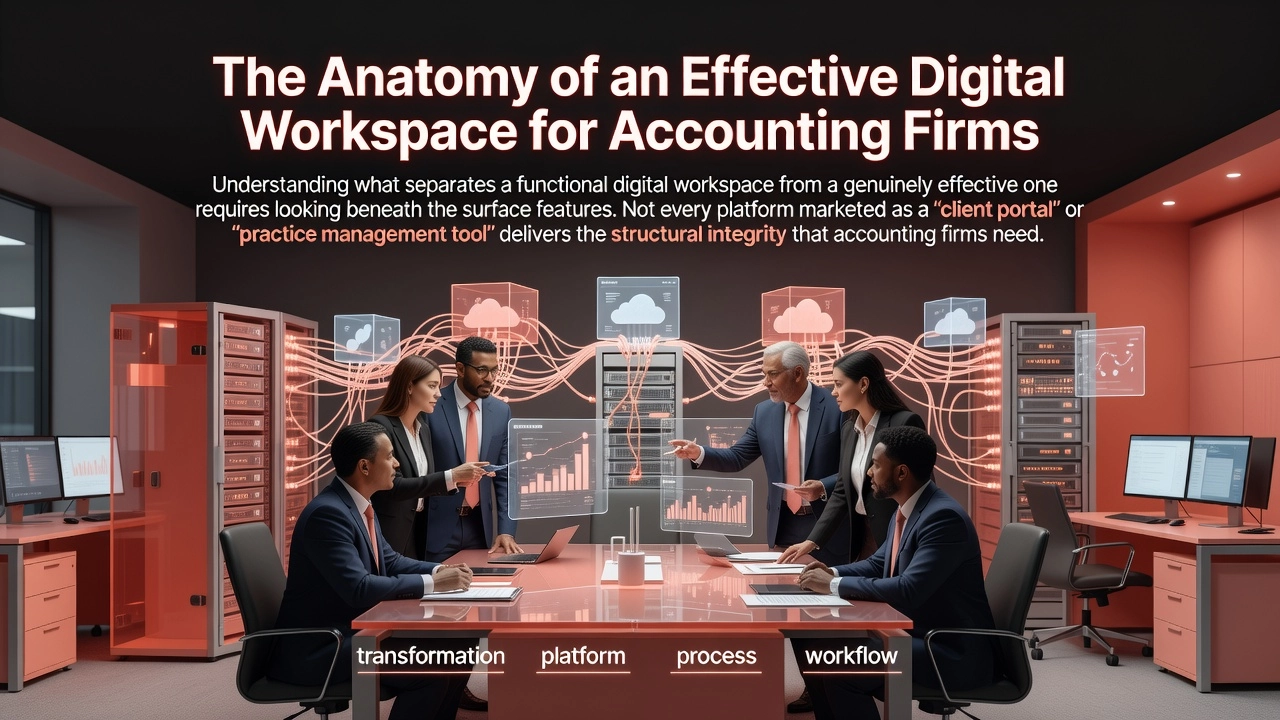
The Anatomy of an Effective Digital Workspace for Accounting Firms
Understanding what separates a functional digital workspace from a genuinely effective one requires looking beneath the surface features. Not every platform marketed as a "client portal" or "practice management tool" delivers the structural integrity that accounting firms need. Six core components define a workspace worth building your firm around.
Centralized Client Communication
The most immediate operational risk in a fragmented firm is information invisibility. When client messages live across individual inboxes, text threads, and forwarded emails, the firm is one staff departure away from a serious service failure. A properly constructed digital workspace makes every message, document request, status update, and client interaction visible to the entire team in a single, structured hub. This is not merely a convenience; it is an institutional knowledge safeguard. When a senior accountant is unavailable, their colleagues can step in without asking the client to repeat themselves or excavating email archives. According to research cited across the industry, 70% of accountants report that clients respond faster through dedicated communication platforms than through conventional email threads, a finding that underscores how much friction scattered communication introduces for both sides of the relationship.
Secure, Structured Document Collection
Email attachments remain the dominant method for document exchange at many firms, despite being structurally inappropriate for sensitive financial data. A purpose-built document collection system does far more than store files securely. It creates structured request workflows, organizes documents by client and engagement type, maintains audit trails showing who uploaded what and when, and preserves version history so that a prior draft of a tax return or financial statement is never accidentally treated as final. Version control, in practical terms, means the workspace timestamps and preserves each iteration of a document, preventing the confusion that arises when multiple versions of a file circulate through email with names like "Final_v3_REVISED_USE THIS ONE." A complete guide to client portals for accounting professionals reinforces that modern clients now expect to upload documents securely at any hour and track the progress of their requests in real time, raising the baseline expectation for what document exchange must look like.
Branded Client Portal
The client-facing layer of a digital workspace is a brand touchpoint, not a utility screen. When clients log in to a generic third-party interface that carries no visual connection to the firm they hired, it introduces subtle doubt about the firm's investment in their experience. A branded portal, carrying the firm's name, logo, and color palette, signals intentionality and professionalism at every interaction. Branding also reduces client hesitation to engage. A familiar visual environment lowers the psychological friction of portal adoption, meaning clients are more likely to complete document requests promptly rather than defaulting to email because the portal "feels like someone else's software." Across the industry, client portal features for accountants in 2026 consistently list branding and white-labeling as must-have capabilities, reflecting that this expectation has moved from premium to standard.
Want to see how this works in practice? Explore Osuria’s client portal
Scalable Workflows
A workspace that works for five clients but buckles under fifty is not a growth asset; it is a ceiling. Scalable workflows mean that the processes governing document collection, task assignment, client communication, and deadline tracking are built into the system's structure rather than dependent on individual memory or manual rebuilding. With 75% of CPAs approaching retirement age and the Bureau of Labor Statistics projecting approximately 130,000 annual accountant job openings, firms cannot afford to rely on institutional knowledge held in individuals' heads. Proactive communication templates, automated reminders, and structured task tracking allow the firm to grow its client roster without a proportional increase in administrative load.
Security and Compliance Readiness
Accounting firms handle some of the most sensitive personal and financial data in existence. Any digital workspace deployed in this environment must meet recognized security standards as a baseline: data encryption at rest and in transit, role-based access controls that limit what each team member and client can see, and comprehensive audit logging that creates a defensible record of every file access and communication event. These are not features to evaluate as optional upgrades; they are the minimum threshold for responsible data stewardship and, increasingly, a client trust signal. Modern client portal software for accountants now embeds identity verification and compliance controls directly into the document collection process, reflecting how thoroughly security has become inseparable from everyday workflow.
One Environment, Not Five Tools
Osuria brings each of these components together in a single secure, branded digital workspace. Client communication, document exchange, task tracking, and proactive updates operate within one coherent environment rather than requiring firms to assemble and maintain a stack of disconnected tools. For accounting firms focused on delivering consistent, professional client service while protecting their margins, that consolidation is not a convenience; it is the architecture on which sustainable growth is built.
How Leading Firms Are Using Digital Workspaces to Scale
 AI generated
The most efficient CPA firms scaling from $1M to $10M in revenue share a structural trait that is rarely discussed openly: their technology stack is not assembled ad hoc for each new client engagement. Instead, client onboarding, document collection, communication, and task management flow through a single connected system. This architectural choice is not incidental. When every new client enters the same standardized pipeline rather than triggering a fresh round of email chains, shared folder creation, and manual follow-up, the firm's capacity to absorb growth without proportional increases in administrative overhead increases substantially. Fragmented stacks introduce coordination costs that compound quietly as headcount and client volume grow, and those costs ultimately limit how far a firm can scale with healthy margins intact.
Compressing Onboarding From Weeks to Days
Cloud-native digital workspaces fundamentally change the onboarding equation by solving a problem that email cannot: defining in advance exactly what information is needed, how it will be requested, and where it will be stored. When those three variables are systematized, the lag between a client signing an engagement letter and productive work actually beginning narrows significantly. The back-and-forth that traditionally delays onboarding, clarifying what documents are required, resending requests, and tracking down outstanding items across disconnected threads, is replaced by a structured request process that clients can complete on their own schedule through a single portal. Research consistently shows that clients respond faster when using dedicated communication platforms rather than scattered email threads, with accounting practice management guides for 2026 explicitly framing standardized onboarding modules as the mechanism that compresses time-to-productive-work across every new engagement.
Standardization as a Scaling Lever
Standardization is the under-appreciated benefit of a unified digital workspace, and it deserves more analytical attention than it typically receives. When every client receives the same structured onboarding sequence, the same proactive update cadence, and the same document request process, service quality becomes a function of firm process rather than individual team member behavior. This distinction matters enormously at scale. A firm where service quality depends on which staff member handles an account has introduced a structural fragility that grows more dangerous as the team expands. A firm where the workspace itself enforces consistency can onboard new team members faster, reduce errors, and maintain client experience quality even during periods of rapid growth or staff transition.
Serving Every Stage of Firm Growth
Firm size considerations shape how a digital workspace must perform in practice. A two-person practice needs simplicity and minimal administrative overhead; a twenty-person firm needs role-based access controls, cross-team visibility, and structured workflows that prevent communication from siloing around individual relationships. The right digital workspace should serve both stages without requiring a disruptive platform migration as the firm grows. Industry analysis of the top accounting practice management platforms consistently frames software selection at growth inflection points as a strategic decision with downstream consequences, because early platform choices either constrain or enable the operational model a firm can eventually build.
Freeing Professionals for Higher-Value Work
Automation of repetitive tasks, specifically document reminders, status updates, and structured client requests, is what ultimately creates capacity for advisory work. This matters beyond simple efficiency. As AI continues to compress margins on compliance-only services, the firms that will sustain profitability are those that have already repositioned their team's time toward higher-value, more defensible advisory relationships. That repositioning is only economically viable when the administrative layer runs without constant manual intervention. A unified digital workspace does not just save time; it redefines what accounting professionals spend their time doing.
Choosing the Right Digital Workspace: What to Evaluate
Not all digital workspaces are built from the same architectural philosophy, and choosing the wrong one creates the exact operational friction firms are trying to eliminate. Before evaluating features, firms need to diagnose where their most significant constraint actually lives.
Workflow-First or Client-Experience-First
The platform market has bifurcated into two distinct design philosophies. Some tools are built around internal operations: task assignment, email thread tracking, deadline management, and team collaboration. Others are architected around the client relationship, treating the branded portal, communication experience, and client-facing interface as the primary product. Both approaches have genuine merit. A firm where missed internal deadlines and broken handoffs are the core pain point will extract faster ROI from a workflow-first tool. A firm losing clients to competitors with more professional, responsive service models needs a client-experience-first platform. The evaluation should begin with an honest assessment of where the firm's operational constraint actually lives, not with a feature comparison spreadsheet.
Branded Experience Depth
Branding capability is more consequential than most buyers realize at the point of purchase. There is a meaningful difference between logo-level branding, where a firm's mark appears inside a vendor's interface, and structural white-labeling, where the vendor is invisible throughout the entire client experience, including the mobile application. For firms where reputation and referral are primary growth drivers, every client interaction that surfaces the vendor's name instead of the firm's name dilutes the professional identity being built. Firms evaluating platforms should ask vendors directly: does the client-facing mobile app carry our firm name in the app store, or yours? The answer has real commercial consequences for advisory-positioned and boutique firms competing on trust.
Client-Side Adoption and Security
A portal that clients abandon in favor of email has a measured ROI of zero. Research indicates that 70% of accountants find clients are more responsive when using dedicated communication platforms rather than scattered email threads, but this outcome depends entirely on the client actually adopting the platform. Accounting clients are frequently non-technical small business owners. A clunky onboarding flow or an unfamiliar interface will be quietly ignored. Firms should pilot any shortlisted platform with three to five actual clients before committing, measuring how quickly those clients complete document uploads and respond to requests without staff assistance. Evaluate the client-facing UX as rigorously as the internal feature set.
Security belongs in the same evaluation tier. The FTC Safeguards Rule and IRS Publication 4557 make this a liability question, not an IT consideration. Verify AES-256 encryption at rest and in transit, multi-factor authentication enforcement, role-based access controls, audit log exportability, and SOC 2 certification status before any contract discussion advances.
Scalability and Total Integration Cost
Scalability failures tend to emerge gradually and then all at once. A platform that handles 15 clients cleanly can become structurally inadequate at 40, particularly when service complexity grows alongside volume. Firms should stress-test any platform against projected client and team sizes at 12, 24, and 36 months, paying close attention to per-user and per-client pricing models that become economically punishing at scale.
The integration cost question deserves the same rigor. A platform requiring separate subscriptions for document management, client messaging, and task tracking is not a digital workspace; it is a starting point with compounding overhead. The true cost of a fragmented stack includes the staff time spent managing integrations, the error risk from data moving between systems, and the cognitive load of training clients across multiple tools. Firms should conduct a straightforward audit: list every tool currently in use, its monthly cost, and the time spent maintaining connections between them. That exercise alone typically makes the case for consolidation concrete and quantifiable.
The Competitive Advantage Is the Client Experience
In 2026, the firms pulling ahead of their competitors are not winning on software features or processing speed. They are winning because their clients feel heard, informed, and confident throughout every interaction. Technical capability has become the baseline; the experience layered on top of that capability is now the differentiator. According to the 2026 Accountant Technology Survey, digital fragmentation remains one of the defining competitive gaps separating firms that scale from those that stagnate. Clients who receive documents through one channel, status updates through another, and invoices through a third do not experience a professional firm. They experience confusion.
Deloitte's research closes this argument decisively. Organizations approaching digital investment with a human-centric lens, prioritizing trust and responsiveness over raw technical capability, are significantly more likely to see returns that exceed expectations. The firms failing to meet that bar are not lacking tools; they are lacking coherence.
Before evaluating new platforms, conduct a straightforward internal audit. Map where client communication currently lives. Identify the three most common sources of administrative friction your team encounters weekly. Evaluate whether your current tools deliver a consistent experience across every client touchpoint, or whether consistency depends on which team member handles the interaction. Finally, assess whether the digital environment your clients encounter reflects the professionalism your firm projects everywhere else.
Frequently Asked Questions About Digital Workspaces for Accounting Firms
What is a digital workspace for an accounting firm? A digital workspace is a unified, secure environment where client communication, document exchange, and task tracking live in one branded place, rather than being scattered across email, shared drives, and personal messaging apps.
Why do accounting firms need a digital workspace instead of generic collaboration tools? Generic tools weren't built for compliance-sensitive, deadline-driven, seasonal work. A purpose-built digital workspace handles the retention, security, and branded client experience that accounting practice specifically requires.
How is a digital workspace different from practice management software? Practice management software is typically internal-facing — task and workflow tracking for the team. A digital workspace centers the client-facing experience: communication, document requests, and status visibility the client interacts with directly.
Osuria was built specifically to close that gap. A secure, branded digital workspace that centralizes client communication, document sharing, and task management, Osuria enables accounting firms to grow without adding administrative complexity. Explore the Digital Workspace or start using Osuria to see the branded client workspace in practice.